

To my brothers and sisters, members of the global wrestling family, and especially to my brothers and sisters in our African continent and in the Arab world,
First of all, if there is a need to give an honest testimony, and if there is a need to speak about history as it was experienced and known in all its details by those who deeply care about the global wrestling family, or about that history which is beginning to be forgotten, then truth must prevail over all the details that have been left unspoken, whether small or great.
If the current circumstances have led each one of us, man or woman, to express a clear and transparent position, sometimes repeatedly and on numerous occasions, there are also attempts to “jump over walls” in order to convey messages whose purpose is sometimes to send coded messages.
But I say this clearly: when it comes to bringing the truth to light, nothing stands above the value of truth and justice.
The difficult period experienced by Moroccan wrestling, when we came within a hair’s breadth of losing our place in the Olympic movement and when the future of our sport was placed under serious question, was a difficult historic moment that we all remember.
And if it is necessary to speak about the role of each one of us during that period, I am merely a humble servant of God. My name is Fouad Meskout, a graduate of the Higher Institute of Journalism and one of the actors in the equation of African, Arab and world wrestling.
That moment was, for all of us, a test, a confrontation and a measure of our faith:
faith in unity,
faith in brotherhood,
faith in putting political colors aside,
and even setting nationalities aside when it came to defending our sport, considering that we had only one nationality: our love for wrestling.
I clearly remember that fifteen members of the Executive Board of the International Olympic Committee were, at that time, behind the difficult decision that threatened to take away our right to dream and our right to breathe the oxygen of the Olympic movement.
Among them was the then Vice-President, Olympic champion Nawal El Moutawakel, the first Arab, African and Muslim woman to win an Olympic gold medal, at the 1984 Los Angeles Olympic Games in the friendly United States of America.
This influential woman was among those who took part in the decision that placed wrestling before this difficult question.
At that time, I was still relatively new to my responsibilities, so I knocked on her door.
Before the eyes of the world, in front of Moroccan official and non-official television, and before an image that is today documented by international wrestling institutions, I stood before her in her office to hand her a letter on behalf of the global wrestling family.
I told her, in essence:
Madam Olympic Champion, before you won your Olympic medal in Los Angeles in 1984, you trained alongside members of the wrestling community in the same space, in Casablanca, Morocco. It was there that a history of pioneering achievements was written—of athletics and of wrestling, both so dear to our hearts.
I call upon this history, and I appeal to you from the heart and from conscience: reconsider, together with your colleagues on the Executive Board of the International Olympic Committee, this difficult decision—this decision that affected our standing and our pride—and defend wrestling’s right to return to its natural and historic place.
Nawal El Moutawakel then stated on Moroccan television, in French, and to Moroccan media, that she was pleased to receive me as President of the Royal Moroccan Wrestling Federation.
More than that, she gave me her personal card, which contained her private telephone number, and told me that I could give it to the interim president, who would have the right to contact her in order to defend ideas and proposals that could contribute to correcting mistakes and moving toward a solution.
Nenad Lalovic then sent me a short message: “Give me her telephone number and email address.”
I sent him the card.
From that moment, communication began, action intensified, and the defense of ideas and principles began, until an official position was established through a historic decision in which we all participated and which we all helped to build.
To this day, I still keep all the correspondence that followed that meeting, received from five continents, all of which recognized the efforts made in defense of wrestling.
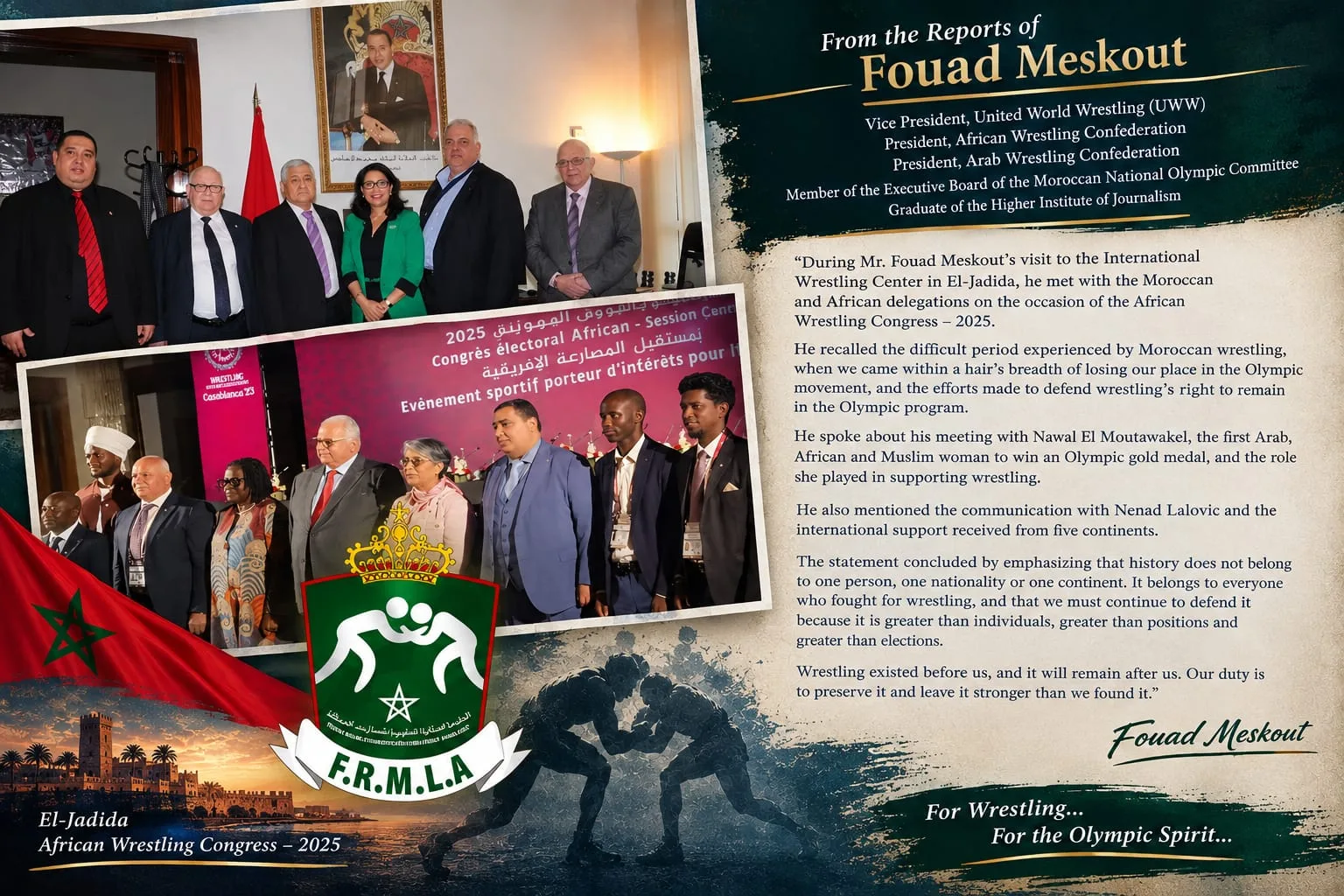
Moreover, when we organized Wrestling Week in Africa here in the heart of the city of El Jadida, with 39 African countries participating, together with the presence of half of the members of the United World Wrestling Bureau, including Nenad Lalovic, and in the presence of Nawal El Moutawakel, the official speeches paid tribute to the role played by Moroccan Fouad Meskout.
And Nawal El Moutawakel herself stated:
“Fouad Meskout, the Moroccan, was the combative defender and passionate lover who fought relentlessly for wrestling’s right to regain its place and its Olympic spirit.”
This is the first part of writing our history.
I revisit this history today so that there may be neither belittling nor falsification, and so that each one of us may know the true role he or she played in defending wrestling with heart and blood.
This testimony can be confirmed by Nenad Lalovic himself, who, to this day as we write this letter, has received from us nothing but support, encouragement, approval and solidarity, as well as our constant commitment to wrestling and its institutions.
As for statements that minimize the efforts and essential roles that contributed to keeping wrestling within the Olympic movement, they should not become part of the difficult path our sport is going through today.
The President is today engaged in a legal battle. This is a matter exclusively for the lawyers he has chosen, and he is leading this process through his own abilities.
I remember that, just a short while ago, we were joking when I told him that the greatest enemy of human beings was obesity and excess weight, and that I myself had fought that enemy until I lost fifty kilograms.
And I say to him today: whoever has managed to fight excess weight with such determination cannot be afraid of difficulties.
I have never seen you surrender in the face of difficulties, neither during your previous journey nor during your current one, when you faced every challenge, often on your own.
We will return to this subject in the second part.
As for this first part, I will share it with every country and with everyone who cares deeply about wrestling, because today we are all called upon to remember the moments when each of us made efforts and sacrifices for world wrestling and to preserve its place within the Olympic movement.
History does not belong to one person, one nationality or one continent.
It belongs to everyone who fought for wrestling, to everyone who carried its concerns, and to everyone who stood beside it when its future was threatened.
At those moments, we were one family.
Today, whatever our differences may be, we must not allow those differences to erase memory or diminish the value of the sacrifices made by men and women from every part of the world.
We defended wrestling because we love it, and we will continue to defend it because we believe it is greater than individuals, greater than positions and greater than elections.
Wrestling existed before us, and it will remain after us. Our duty is to preserve it and leave it stronger than we found it.
With my love for wrestling and for all of you,
Fouad Meskout
Vice President, United World Wrestling (UWW)
President, African Wrestling Confederation
President, Arab Wrestling Confederation
Member of the Executive Board of the Moroccan National Olympic Committee
Graduate of the Higher Institute of Journalism